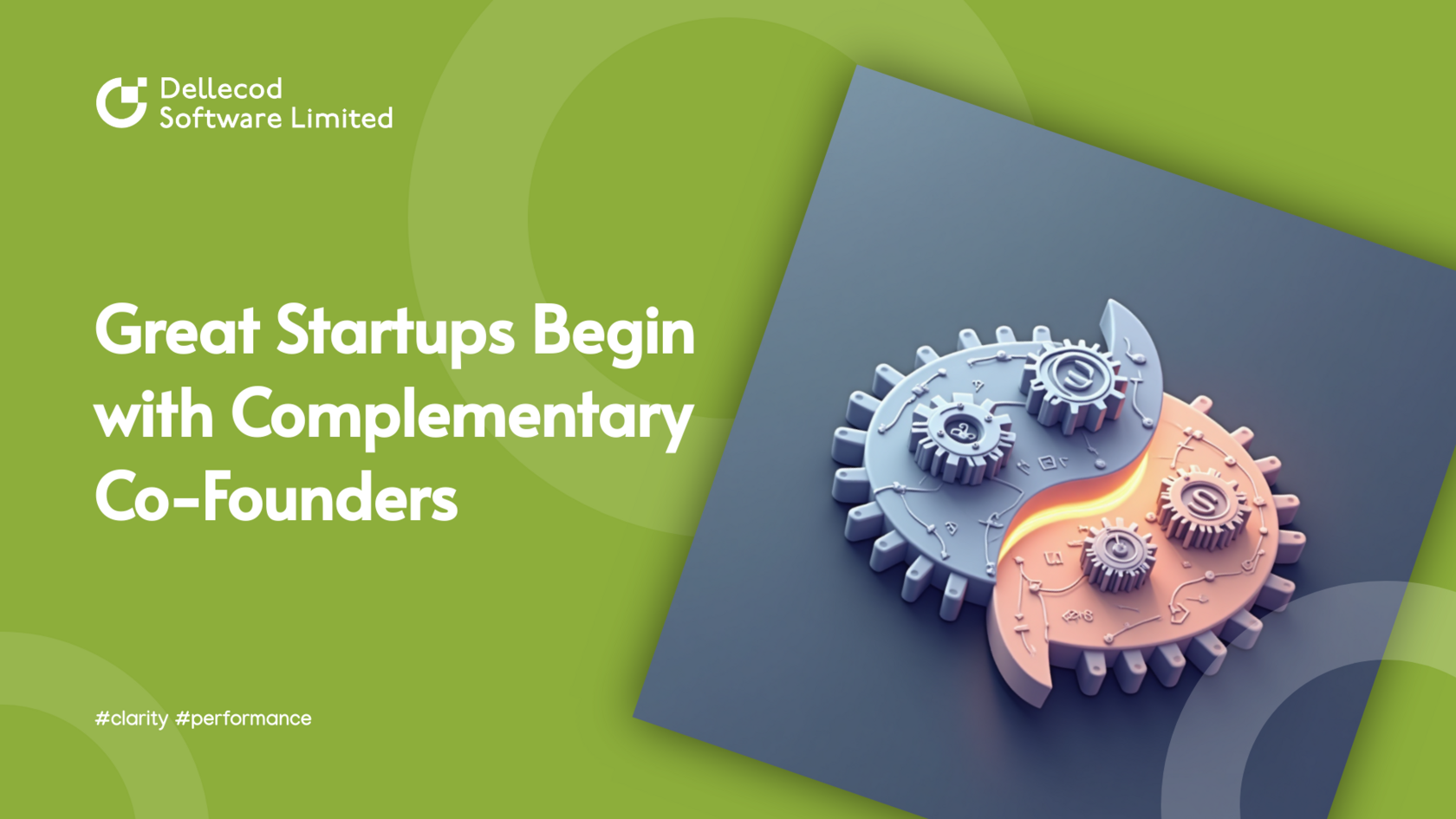
At Dellecod Software, we've spent a lot of time thinking about what makes a founding team work — not just in theory, but through lived experience, hard decisions, and a few hard-won lessons. One truth we've seen consistently: the best founding teams often start with two people, each bringing something fundamentally different and essential to the table.
It's tempting to romanticize the idea of the solo founder — one person with a big vision, a whiteboard, and endless endurance. But building a successful product company rarely works that way. There are simply too many dimensions to cover: product, market, vision, execution, technology, customers, hiring, strategy. Trying to hold all these threads with one pair of hands is an extraordinary burden.
Two founders, ideally, allow for a kind of creative and operational completeness. But not just any two.
The most resilient pairs we’ve observed — including in our own work — follow a pattern. One is the Inventor. The other is the Entrepreneur.
The Inventor brings deep creative insight into the product. They don’t just code or design — they rethink. They see what's broken today and imagine what could be better. Often, dramatically better. This person isn't satisfied with being slightly different from existing products; they're aiming for something 10x better. They obsess over the details others overlook. They're not building a solution for a market yet — they’re building the best possible version of what should exist.
The Entrepreneur takes that early spark and fans it into a flame. They go beyond telling a good story. They find the customers, understand the dynamics, shape the go-to-market motion, and eventually build an organization around it. They don’t need the reassurance of a perfect product before taking it to market. They’re comfortable navigating ambiguity — where value is still potential rather than proof.
Where this gets interesting is that the roles aren’t opposites, and the best-case scenario is when there's shared understanding between both. The Inventor should care about how the market responds; the Entrepreneur should know the product well enough to speak to its strengths and weaknesses. But at their core, each needs to be world-class at their foundation.
It’s a recipe that sounds simple, but it’s difficult to pull off. People naturally cluster with similar types. Engineers find engineers. Operators find other operators. But difference is where the tension — and the progress — comes from.
We’ve seen teams struggle where there’s overlap but no complement, or where neither founder is exceptional in their core competency. Two entrepreneurs without an inventor risk building a business without a differentiated product. Two inventors without an entrepreneur might spend years crafting something brilliant that no one adopts.
In early-stage companies, the impact — and limitations — of the founding team echo loudly and persist for years. Choices made in the early days become part of the company's DNA.
So when people ask us what to look for in a co-founder, or how to build a strong foundation, this is often where we point them. You don’t need three or four people to begin. Two can be plenty, if each brings sharp focus, high standards in one core dimension, and empathy for the other.
It's not about splitting the company down the middle. It’s about letting deep complementary strengths pull the idea forward — together.
It's tempting to romanticize the idea of the solo founder — one person with a big vision, a whiteboard, and endless endurance. But building a successful product company rarely works that way. There are simply too many dimensions to cover: product, market, vision, execution, technology, customers, hiring, strategy. Trying to hold all these threads with one pair of hands is an extraordinary burden.
Two founders, ideally, allow for a kind of creative and operational completeness. But not just any two.
The most resilient pairs we’ve observed — including in our own work — follow a pattern. One is the Inventor. The other is the Entrepreneur.
The Inventor brings deep creative insight into the product. They don’t just code or design — they rethink. They see what's broken today and imagine what could be better. Often, dramatically better. This person isn't satisfied with being slightly different from existing products; they're aiming for something 10x better. They obsess over the details others overlook. They're not building a solution for a market yet — they’re building the best possible version of what should exist.
The Entrepreneur takes that early spark and fans it into a flame. They go beyond telling a good story. They find the customers, understand the dynamics, shape the go-to-market motion, and eventually build an organization around it. They don’t need the reassurance of a perfect product before taking it to market. They’re comfortable navigating ambiguity — where value is still potential rather than proof.
Where this gets interesting is that the roles aren’t opposites, and the best-case scenario is when there's shared understanding between both. The Inventor should care about how the market responds; the Entrepreneur should know the product well enough to speak to its strengths and weaknesses. But at their core, each needs to be world-class at their foundation.
It’s a recipe that sounds simple, but it’s difficult to pull off. People naturally cluster with similar types. Engineers find engineers. Operators find other operators. But difference is where the tension — and the progress — comes from.
We’ve seen teams struggle where there’s overlap but no complement, or where neither founder is exceptional in their core competency. Two entrepreneurs without an inventor risk building a business without a differentiated product. Two inventors without an entrepreneur might spend years crafting something brilliant that no one adopts.
In early-stage companies, the impact — and limitations — of the founding team echo loudly and persist for years. Choices made in the early days become part of the company's DNA.
So when people ask us what to look for in a co-founder, or how to build a strong foundation, this is often where we point them. You don’t need three or four people to begin. Two can be plenty, if each brings sharp focus, high standards in one core dimension, and empathy for the other.
It's not about splitting the company down the middle. It’s about letting deep complementary strengths pull the idea forward — together.