At Dellecod, we talk a lot about the intersection between experience and conviction. It comes up in engineering, product decisions, hiring, even casual conversations. How much of building something great comes from pedigree — and how much comes from raw determination?
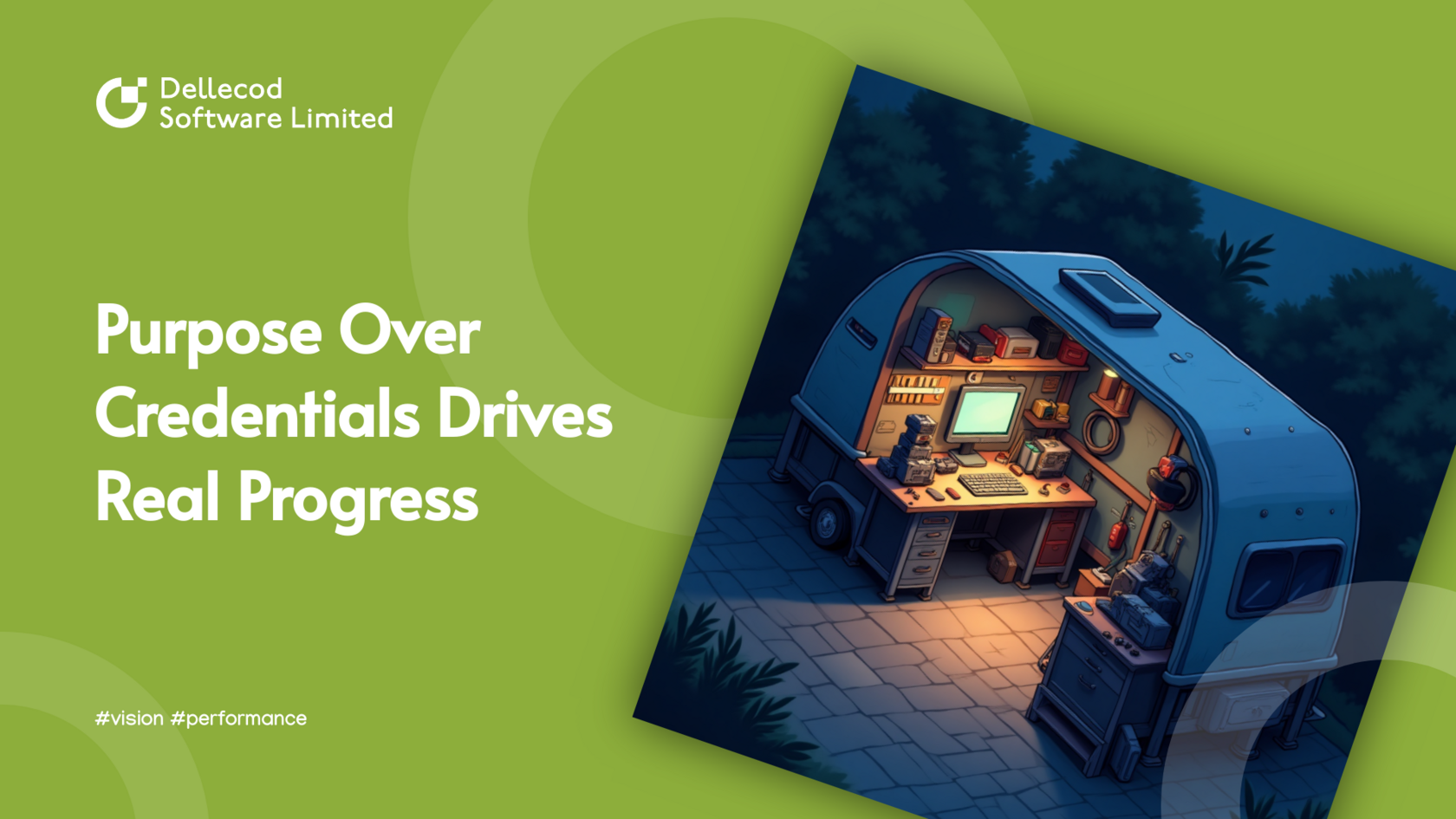
We recently watched a talk from the founder of Oculus VR that left many of us quietly reflecting. At 19, he launched a company from a trailer park while attending school. No prior executive experience, no management credentials, no exposure to global operations. Just a stubborn belief in a technology’s future, a willingness to figure it out, and an ability to convince others to join him.
Within a few years, Oculus became a global force in virtual reality, with thousands of employees and millions of devices shipped. That journey didn’t happen because he had the perfect résumé. In fact, he makes a point of saying what most people are hesitant to admit: that he probably wasn’t the most qualified person for the job.
That kind of humility — paired with a clear-eyed sense of purpose — is something we relate to more than we might have expected.
Impostor syndrome is familiar territory for anyone trying to build something from scratch. There’s always someone with more experience, more polish, more textbook answers. The tension isn’t about whether those people exist (they always do) but whether you’re the one who’s going to care about the problem enough to wake up thinking about it every single day. Whether you’ll invest the emotional labor, the late nights, and the stubborn cycles of trial-and-error that actually create momentum.
In our field, particularly when we're working with systems that impact real people — financial tools, logistics platforms, sometimes public infrastructure — we feel that same pressure he described when talking about national security. That internal voice asking, “Are you the right person to make this decision?” It’s healthy. It pushes us to ask better questions, to consult more deeply, to never assume we’ve earned anyone’s trust automatically.
But there’s a risk, too, in waiting for the perfect qualifications to show up before you start.
Some of the most meaningful innovations we’ve seen — not just in tech, but in science, direct service, even public policy — began with people who were more driven than credentialed. People who respected the complexity of a challenge but were undeterred by not having the “traditional” background.
We’re not advocating for recklessness or arrogance. Experience matters. It compresses learning curves and prevents avoidable mistakes. But experience alone isn’t what gets a new product over the finish line. It’s not what convinces a dozen early employees to join a long shot. And it’s never what keeps you going when the easy option is to quit. That comes down to purpose. To choosing to care more than is efficient. To showing up not because you’re the most qualified on paper — but because you believe that someone should, and you’re willing to be the one.
So when we look at stories like Oculus — or, honestly, even our own small internal wins — we’re reminded that nothing worth building begins with certainty. It starts in motion. And conviction, when aligned with purpose, often beats perfect credentials. Every time.
We recently watched a talk from the founder of Oculus VR that left many of us quietly reflecting. At 19, he launched a company from a trailer park while attending school. No prior executive experience, no management credentials, no exposure to global operations. Just a stubborn belief in a technology’s future, a willingness to figure it out, and an ability to convince others to join him.
Within a few years, Oculus became a global force in virtual reality, with thousands of employees and millions of devices shipped. That journey didn’t happen because he had the perfect résumé. In fact, he makes a point of saying what most people are hesitant to admit: that he probably wasn’t the most qualified person for the job.
That kind of humility — paired with a clear-eyed sense of purpose — is something we relate to more than we might have expected.
Impostor syndrome is familiar territory for anyone trying to build something from scratch. There’s always someone with more experience, more polish, more textbook answers. The tension isn’t about whether those people exist (they always do) but whether you’re the one who’s going to care about the problem enough to wake up thinking about it every single day. Whether you’ll invest the emotional labor, the late nights, and the stubborn cycles of trial-and-error that actually create momentum.
In our field, particularly when we're working with systems that impact real people — financial tools, logistics platforms, sometimes public infrastructure — we feel that same pressure he described when talking about national security. That internal voice asking, “Are you the right person to make this decision?” It’s healthy. It pushes us to ask better questions, to consult more deeply, to never assume we’ve earned anyone’s trust automatically.
But there’s a risk, too, in waiting for the perfect qualifications to show up before you start.
Some of the most meaningful innovations we’ve seen — not just in tech, but in science, direct service, even public policy — began with people who were more driven than credentialed. People who respected the complexity of a challenge but were undeterred by not having the “traditional” background.
We’re not advocating for recklessness or arrogance. Experience matters. It compresses learning curves and prevents avoidable mistakes. But experience alone isn’t what gets a new product over the finish line. It’s not what convinces a dozen early employees to join a long shot. And it’s never what keeps you going when the easy option is to quit. That comes down to purpose. To choosing to care more than is efficient. To showing up not because you’re the most qualified on paper — but because you believe that someone should, and you’re willing to be the one.
So when we look at stories like Oculus — or, honestly, even our own small internal wins — we’re reminded that nothing worth building begins with certainty. It starts in motion. And conviction, when aligned with purpose, often beats perfect credentials. Every time.