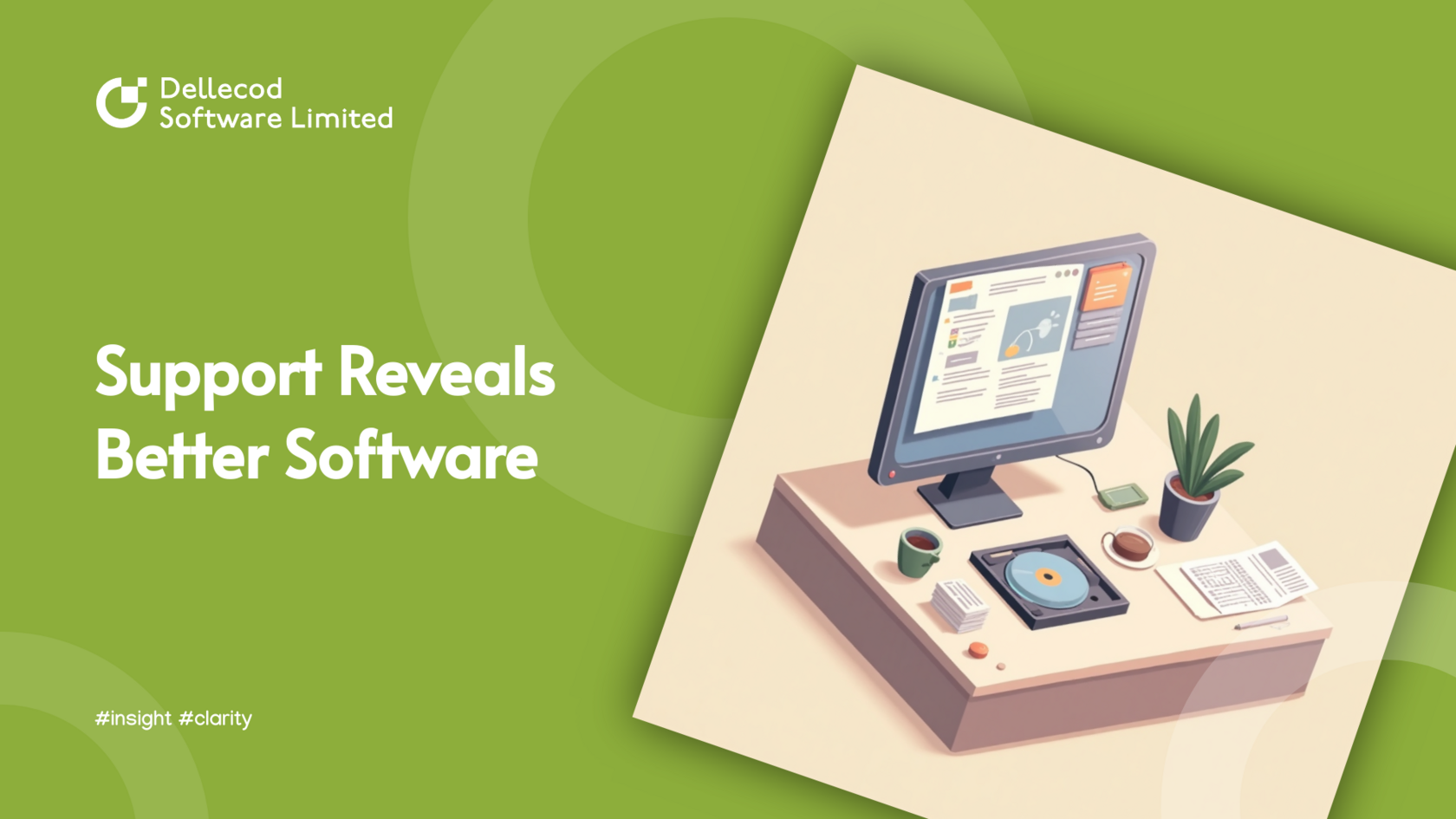
There is something wonderfully revealing about early tech support stories.
On the surface, they are usually funny. Someone mistakes a CD-ROM tray for a cup holder. A bug report arrives that is not really about software at all, but about a machine that has been misunderstood in a very human way. The support inbox becomes a strange crossroads where engineering, confusion, expectation, and everyday life all meet.
But beneath the humor, there is a deeper lesson about technology that still feels relevant now.
One of the more interesting details in this old Mosaic-era anecdote is not just that the browser had a support inbox, but that the inbox represented something much larger. At that point, if you were supporting the browser most people used to access the web, you were not just supporting a product. In a practical sense, you were supporting people’s understanding of the internet itself.
That distinction matters.
When technology is new, users do not experience it in neat categories. They do not separate the browser from the operating system, the machine from the network, or the software issue from the physical object sitting on the desk. They encounter one thing: a confusing system they are trying to make useful.
So the support request sent to the browser team is rarely just about the browser. It is about the entire experience of entering a new world.
We still see versions of this today, even if the details have changed. Users do not always know whether a problem belongs to the app, the device, the network, the account, the browser, the cloud provider, or their own workflow. And honestly, they should not have to think about those layers as much as we do. Most people are not trying to understand architecture diagrams. They are trying to finish a task.
That is why stories like the CD-ROM cup holder anecdote stay with people. They are easy to laugh at, but they also expose a recurring blind spot in the way builders think. We often assume the intended use of a tool is obvious because it is obvious to us. We know what the tray is for. We know what counts as a software issue. We know where one boundary ends and another begins.
Users do not live inside those assumptions.
And that is not a failure of users. It is a reminder that design is always an act of translation.
At Dellecod Software, one of the lessons we return to often is that technical clarity and user clarity are not the same thing. A system can be well engineered and still feel obscure. A feature can be logically correct and still invite misuse. An error message can be precise and still leave someone with no idea what to do next.
Support, in that sense, is one of the most honest mirrors a product team can have.
It tells you where your mental model differs from the user’s. It shows you where the interface asks people to make leaps they were never prepared to make. It reveals when documentation is compensating for design that should have been more intuitive in the first place.
The teams that pay attention to support conversations tend to learn faster, not because every support request contains a roadmap item, but because every request contains context. It tells you how the product is being understood out in the wild, where no one is present to explain it.
That is part of what makes the early internet support story so compelling. An inbox full of questions about Mosaic was also an inbox full of questions about what computing meant for ordinary people. The support role sat at the boundary between invention and adoption. It was not just troubleshooting. It was interpretation.
There is also something humbling in that.
People working close to technology can become impatient with basic misunderstandings. We have all seen examples that seem absurd from the inside. But if enough people make the same mistake, the interesting question is not, “Why did they do that?” It is, “What did the product fail to communicate?”
Sometimes the answer is visual design. Sometimes naming. Sometimes onboarding. Sometimes the problem is that a product arrives before conventions have matured around it. Early users of the web did not inherit decades of shared digital habits. They were learning by touching unfamiliar systems and seeing what happened.
In a way, that made support a front-row seat to the formation of digital literacy.
Today, we like to imagine that users are more sophisticated, and in many ways they are. But every new technical wave resets the pattern. AI tools, automation platforms, crypto products, spatial interfaces, connected devices — each brings its own version of the same old story. The terminology feels natural to the builders and foreign to everyone else. The edge cases seem rare until they flood the inbox. The “obvious” interaction turns out not to be obvious at all.
And once again, support becomes a map of reality.
Not the reality of how the product was specified, but the reality of how it is encountered.
That is why mature teams treat support as more than a reactive function. It is a source of product intelligence. It helps answer questions analytics alone cannot answer. Why did this person trust the wrong button? What did they expect to happen here? What assumption led them into trouble? What language would have met them where they were?
The cup holder story is memorable because it is funny, yes. But it also points to a broader truth: people use technology through analogy. They interpret unfamiliar objects by comparing them to familiar ones. If something looks like a tray, they may treat it like a tray. If a workflow resembles email, they may expect email-like behavior. If a dashboard appears complete, they may assume the data is final.
Users are always making meaning. Good products guide that meaning gently.
There is a certain calm discipline required to build this way. It means resisting the temptation to dismiss confusion as user error. It means looking at friction as information. It means remembering that every polished system rests on thousands of moments where someone got stuck, asked a question, misunderstood an object, or clicked the wrong thing.
Those moments are not peripheral to the product. They are part of the product.
Early internet support had a special kind of intimacy because everything felt new and slightly unformed. One inbox could become the place where an entire class of uncertainty arrived. That era is easy to romanticize, but the underlying lesson is current: the real work of software is not only to function, but to make sense.
And if we are paying attention, the people who struggle with our tools are often the ones showing us most clearly what still needs to be improved.
That is a useful perspective to keep, especially now. Technology continues to accelerate. Interfaces become more abstract. Systems become more powerful and less visible. The gap between what a machine is doing and what a person thinks it is doing can widen very quickly.
Which brings us back to that support inbox.
An inbox like that is not just a queue of problems. It is a record of contact between human expectation and technical reality. Sometimes that contact is messy. Sometimes it is funny. Sometimes it reveals design flaws no planning session anticipated. But almost always, it teaches something.
If we are wise, we treat those lessons with respect.
Because behind every seemingly simple support question is a person trying to trust a system they do not fully understand yet. And behind every good product is a team that learned how to listen when that trust wavered.
On the surface, they are usually funny. Someone mistakes a CD-ROM tray for a cup holder. A bug report arrives that is not really about software at all, but about a machine that has been misunderstood in a very human way. The support inbox becomes a strange crossroads where engineering, confusion, expectation, and everyday life all meet.
But beneath the humor, there is a deeper lesson about technology that still feels relevant now.
One of the more interesting details in this old Mosaic-era anecdote is not just that the browser had a support inbox, but that the inbox represented something much larger. At that point, if you were supporting the browser most people used to access the web, you were not just supporting a product. In a practical sense, you were supporting people’s understanding of the internet itself.
That distinction matters.
When technology is new, users do not experience it in neat categories. They do not separate the browser from the operating system, the machine from the network, or the software issue from the physical object sitting on the desk. They encounter one thing: a confusing system they are trying to make useful.
So the support request sent to the browser team is rarely just about the browser. It is about the entire experience of entering a new world.
We still see versions of this today, even if the details have changed. Users do not always know whether a problem belongs to the app, the device, the network, the account, the browser, the cloud provider, or their own workflow. And honestly, they should not have to think about those layers as much as we do. Most people are not trying to understand architecture diagrams. They are trying to finish a task.
That is why stories like the CD-ROM cup holder anecdote stay with people. They are easy to laugh at, but they also expose a recurring blind spot in the way builders think. We often assume the intended use of a tool is obvious because it is obvious to us. We know what the tray is for. We know what counts as a software issue. We know where one boundary ends and another begins.
Users do not live inside those assumptions.
And that is not a failure of users. It is a reminder that design is always an act of translation.
At Dellecod Software, one of the lessons we return to often is that technical clarity and user clarity are not the same thing. A system can be well engineered and still feel obscure. A feature can be logically correct and still invite misuse. An error message can be precise and still leave someone with no idea what to do next.
Support, in that sense, is one of the most honest mirrors a product team can have.
It tells you where your mental model differs from the user’s. It shows you where the interface asks people to make leaps they were never prepared to make. It reveals when documentation is compensating for design that should have been more intuitive in the first place.
The teams that pay attention to support conversations tend to learn faster, not because every support request contains a roadmap item, but because every request contains context. It tells you how the product is being understood out in the wild, where no one is present to explain it.
That is part of what makes the early internet support story so compelling. An inbox full of questions about Mosaic was also an inbox full of questions about what computing meant for ordinary people. The support role sat at the boundary between invention and adoption. It was not just troubleshooting. It was interpretation.
There is also something humbling in that.
People working close to technology can become impatient with basic misunderstandings. We have all seen examples that seem absurd from the inside. But if enough people make the same mistake, the interesting question is not, “Why did they do that?” It is, “What did the product fail to communicate?”
Sometimes the answer is visual design. Sometimes naming. Sometimes onboarding. Sometimes the problem is that a product arrives before conventions have matured around it. Early users of the web did not inherit decades of shared digital habits. They were learning by touching unfamiliar systems and seeing what happened.
In a way, that made support a front-row seat to the formation of digital literacy.
Today, we like to imagine that users are more sophisticated, and in many ways they are. But every new technical wave resets the pattern. AI tools, automation platforms, crypto products, spatial interfaces, connected devices — each brings its own version of the same old story. The terminology feels natural to the builders and foreign to everyone else. The edge cases seem rare until they flood the inbox. The “obvious” interaction turns out not to be obvious at all.
And once again, support becomes a map of reality.
Not the reality of how the product was specified, but the reality of how it is encountered.
That is why mature teams treat support as more than a reactive function. It is a source of product intelligence. It helps answer questions analytics alone cannot answer. Why did this person trust the wrong button? What did they expect to happen here? What assumption led them into trouble? What language would have met them where they were?
The cup holder story is memorable because it is funny, yes. But it also points to a broader truth: people use technology through analogy. They interpret unfamiliar objects by comparing them to familiar ones. If something looks like a tray, they may treat it like a tray. If a workflow resembles email, they may expect email-like behavior. If a dashboard appears complete, they may assume the data is final.
Users are always making meaning. Good products guide that meaning gently.
There is a certain calm discipline required to build this way. It means resisting the temptation to dismiss confusion as user error. It means looking at friction as information. It means remembering that every polished system rests on thousands of moments where someone got stuck, asked a question, misunderstood an object, or clicked the wrong thing.
Those moments are not peripheral to the product. They are part of the product.
Early internet support had a special kind of intimacy because everything felt new and slightly unformed. One inbox could become the place where an entire class of uncertainty arrived. That era is easy to romanticize, but the underlying lesson is current: the real work of software is not only to function, but to make sense.
And if we are paying attention, the people who struggle with our tools are often the ones showing us most clearly what still needs to be improved.
That is a useful perspective to keep, especially now. Technology continues to accelerate. Interfaces become more abstract. Systems become more powerful and less visible. The gap between what a machine is doing and what a person thinks it is doing can widen very quickly.
Which brings us back to that support inbox.
An inbox like that is not just a queue of problems. It is a record of contact between human expectation and technical reality. Sometimes that contact is messy. Sometimes it is funny. Sometimes it reveals design flaws no planning session anticipated. But almost always, it teaches something.
If we are wise, we treat those lessons with respect.
Because behind every seemingly simple support question is a person trying to trust a system they do not fully understand yet. And behind every good product is a team that learned how to listen when that trust wavered.