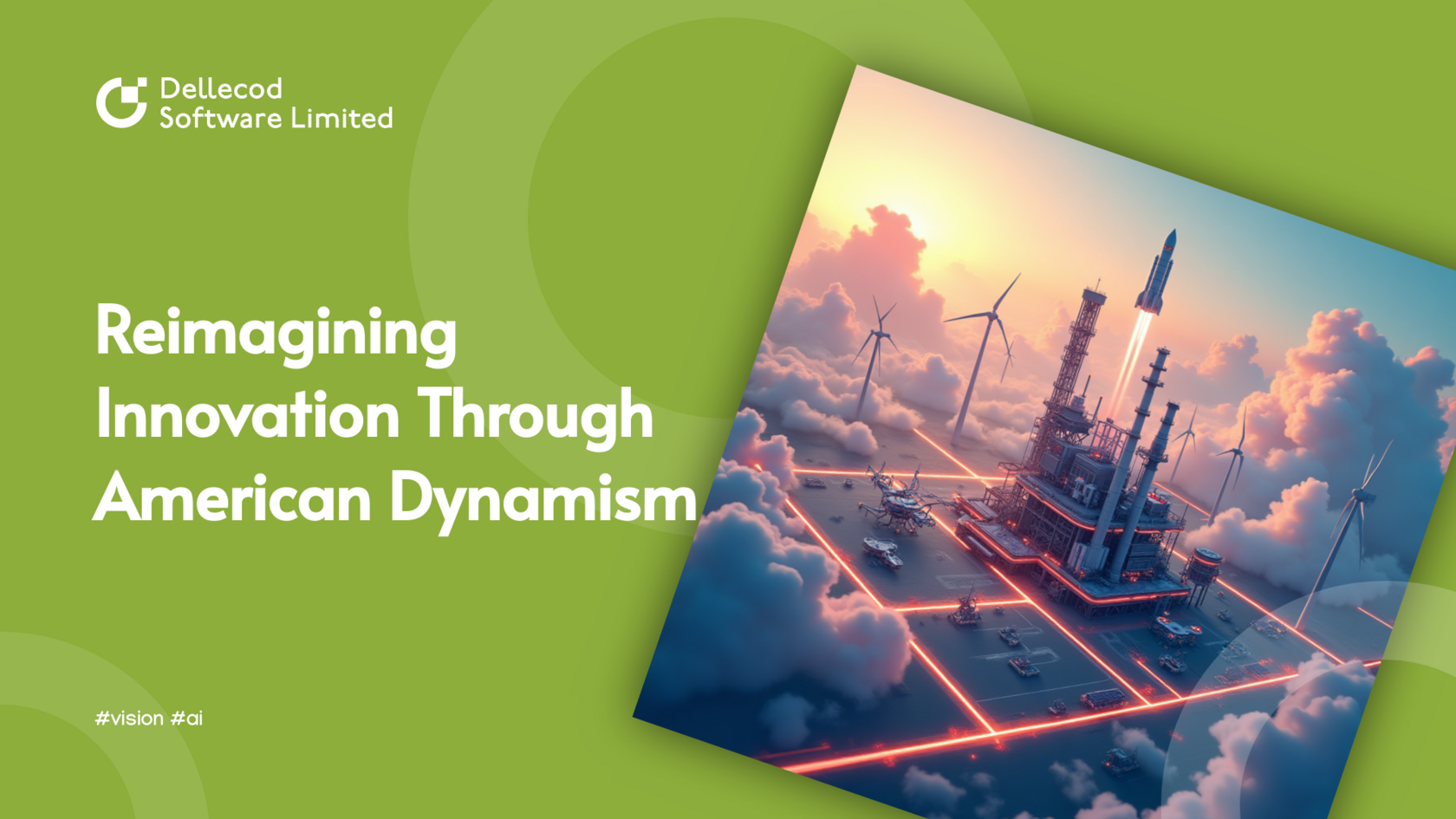
If you take a step back and look at what’s happening across the technology and public policy landscape in the United States, there’s a subtle but powerful shift underway — one that feels timely, rooted, and necessary. It's being called “American Dynamism,” though its character runs deeper than any label. At a glance, it's a renewed alignment between innovation ecosystems and national interests. But in practice, it’s something more personal: a sense that doing hard things for the right reasons is back on the table.
For those of us in technology, the past few decades have felt largely divorced from some of these foundational ideas. The dominant narrative was that progress meant optimized ad targeting, faster delivery apps, or fewer clicks between us and the next dopamine hit. Some of that work created real value — much of it did. But somewhere along the way, a certain type of ambition began to feel old-fashioned: the audacity to build things that move atoms, not just bits. To work on infrastructure, energy grids, and tools that matter in war and peace. To understand that freedom, innovation, and decentralization aren’t just buzzwords — they are strategic advantages.
American Dynamism reflects this turn. It's not a retreat from software or consumer platforms. It’s a realization that those tools are necessary but not sufficient. It’s a movement that bounds back from the screen and returns to the messy, physical world. And this time, with better tools: modern manufacturing processes, AI-enabled systems, agile satellite networks, autonomous drones. These aren't speculative ideas — they’re happening in real time, led by engineers coming out of SpaceX or the Navy, building companies that merge domain expertise with deep mission alignment.
The motivations are often more than economic. Founders in this space are asking bigger questions. What does it mean to build for your country? What systems, if they fail, would threaten our way of life? What can startups do that institutions — too slow, too bound by bureaucracy — can’t? And perhaps most importantly: what kind of technological foundation will the next generation inherit?
There’s a fascinating tension at the heart of all this. On one end, the continued rise of authoritarian models, especially China’s centralized control systems. On the other, a decentralized culture of scrappy innovation and entrepreneurial risk-taking — one that’s messy by design but resilient in a way central planning can’t be. American Dynamism is a bet that this open, creative system still works — that in moments of geopolitical uncertainty, this is where the most potent innovation can come from.
Understandably, some in Washington, D.C., still struggle to bridge the language and cycle time differences with startups. Five-year procurement cycles are a relic in an industry that now iterates in months or weeks. We’re seeing signs of change — pushes for procurement reform, more partnership with early-stage companies, and a growing appreciation that the future of defense will require distributed, flexible, and attritable systems rather than towering, slow-rolling legacy platforms.
And it's not just defense. Energy, education, manufacturing — they’re all on the table. Not to restore some nostalgic version of mid-century America, but to reimagine how we build in ways that are smarter, faster, greener, and more distributed. You don’t rebuild a semiconductor supply chain by wishing steel factories back into existence. You build vertically integrated fabs with AI systems baked in from day one. You rethink how satellites are designed and launched, like Apex Space getting to orbit from a clean sheet in just over a year. You fund advanced energy startups that treat climate and resilience as national security priorities.
Much of this would’ve been unthinkable a decade ago. But something has changed. Maybe it’s the global volatility. Maybe it’s a deeper cultural reassessment. Or maybe — finally — the tech sector has come full circle and rediscovered its roots in solving hard, real problems. In any case, it feels like a moment: not loud, not manic, but sure-footed in its urgency.
At Dellecod, this resonates. We’re not in aerospace, nor nuclear energy. But we share this belief that software is entering a new phase — one where it doesn’t just scale business models, but recalibrates society’s critical infrastructure. The conversations we’re having now — with customers, researchers, public sector partners — aren’t about flashy disruption. They’re about reliability, resilience, and rethinking how fundamental systems get built.
American Dynamism invites technologists to think beyond product-market fit and toward systems-level impact. It’s OK to want to build something useful, stable, and enduring. It’s patriotic, even.
We don’t need to copy centralized models to stay competitive. We need to do what we’ve always done at our best: empower small teams, decentralize ownership, and move fast in service of something greater than ourselves.
You could call it a comeback. Or maybe, just maybe, it's the next frontier.
For those of us in technology, the past few decades have felt largely divorced from some of these foundational ideas. The dominant narrative was that progress meant optimized ad targeting, faster delivery apps, or fewer clicks between us and the next dopamine hit. Some of that work created real value — much of it did. But somewhere along the way, a certain type of ambition began to feel old-fashioned: the audacity to build things that move atoms, not just bits. To work on infrastructure, energy grids, and tools that matter in war and peace. To understand that freedom, innovation, and decentralization aren’t just buzzwords — they are strategic advantages.
American Dynamism reflects this turn. It's not a retreat from software or consumer platforms. It’s a realization that those tools are necessary but not sufficient. It’s a movement that bounds back from the screen and returns to the messy, physical world. And this time, with better tools: modern manufacturing processes, AI-enabled systems, agile satellite networks, autonomous drones. These aren't speculative ideas — they’re happening in real time, led by engineers coming out of SpaceX or the Navy, building companies that merge domain expertise with deep mission alignment.
The motivations are often more than economic. Founders in this space are asking bigger questions. What does it mean to build for your country? What systems, if they fail, would threaten our way of life? What can startups do that institutions — too slow, too bound by bureaucracy — can’t? And perhaps most importantly: what kind of technological foundation will the next generation inherit?
There’s a fascinating tension at the heart of all this. On one end, the continued rise of authoritarian models, especially China’s centralized control systems. On the other, a decentralized culture of scrappy innovation and entrepreneurial risk-taking — one that’s messy by design but resilient in a way central planning can’t be. American Dynamism is a bet that this open, creative system still works — that in moments of geopolitical uncertainty, this is where the most potent innovation can come from.
Understandably, some in Washington, D.C., still struggle to bridge the language and cycle time differences with startups. Five-year procurement cycles are a relic in an industry that now iterates in months or weeks. We’re seeing signs of change — pushes for procurement reform, more partnership with early-stage companies, and a growing appreciation that the future of defense will require distributed, flexible, and attritable systems rather than towering, slow-rolling legacy platforms.
And it's not just defense. Energy, education, manufacturing — they’re all on the table. Not to restore some nostalgic version of mid-century America, but to reimagine how we build in ways that are smarter, faster, greener, and more distributed. You don’t rebuild a semiconductor supply chain by wishing steel factories back into existence. You build vertically integrated fabs with AI systems baked in from day one. You rethink how satellites are designed and launched, like Apex Space getting to orbit from a clean sheet in just over a year. You fund advanced energy startups that treat climate and resilience as national security priorities.
Much of this would’ve been unthinkable a decade ago. But something has changed. Maybe it’s the global volatility. Maybe it’s a deeper cultural reassessment. Or maybe — finally — the tech sector has come full circle and rediscovered its roots in solving hard, real problems. In any case, it feels like a moment: not loud, not manic, but sure-footed in its urgency.
At Dellecod, this resonates. We’re not in aerospace, nor nuclear energy. But we share this belief that software is entering a new phase — one where it doesn’t just scale business models, but recalibrates society’s critical infrastructure. The conversations we’re having now — with customers, researchers, public sector partners — aren’t about flashy disruption. They’re about reliability, resilience, and rethinking how fundamental systems get built.
American Dynamism invites technologists to think beyond product-market fit and toward systems-level impact. It’s OK to want to build something useful, stable, and enduring. It’s patriotic, even.
We don’t need to copy centralized models to stay competitive. We need to do what we’ve always done at our best: empower small teams, decentralize ownership, and move fast in service of something greater than ourselves.
You could call it a comeback. Or maybe, just maybe, it's the next frontier.