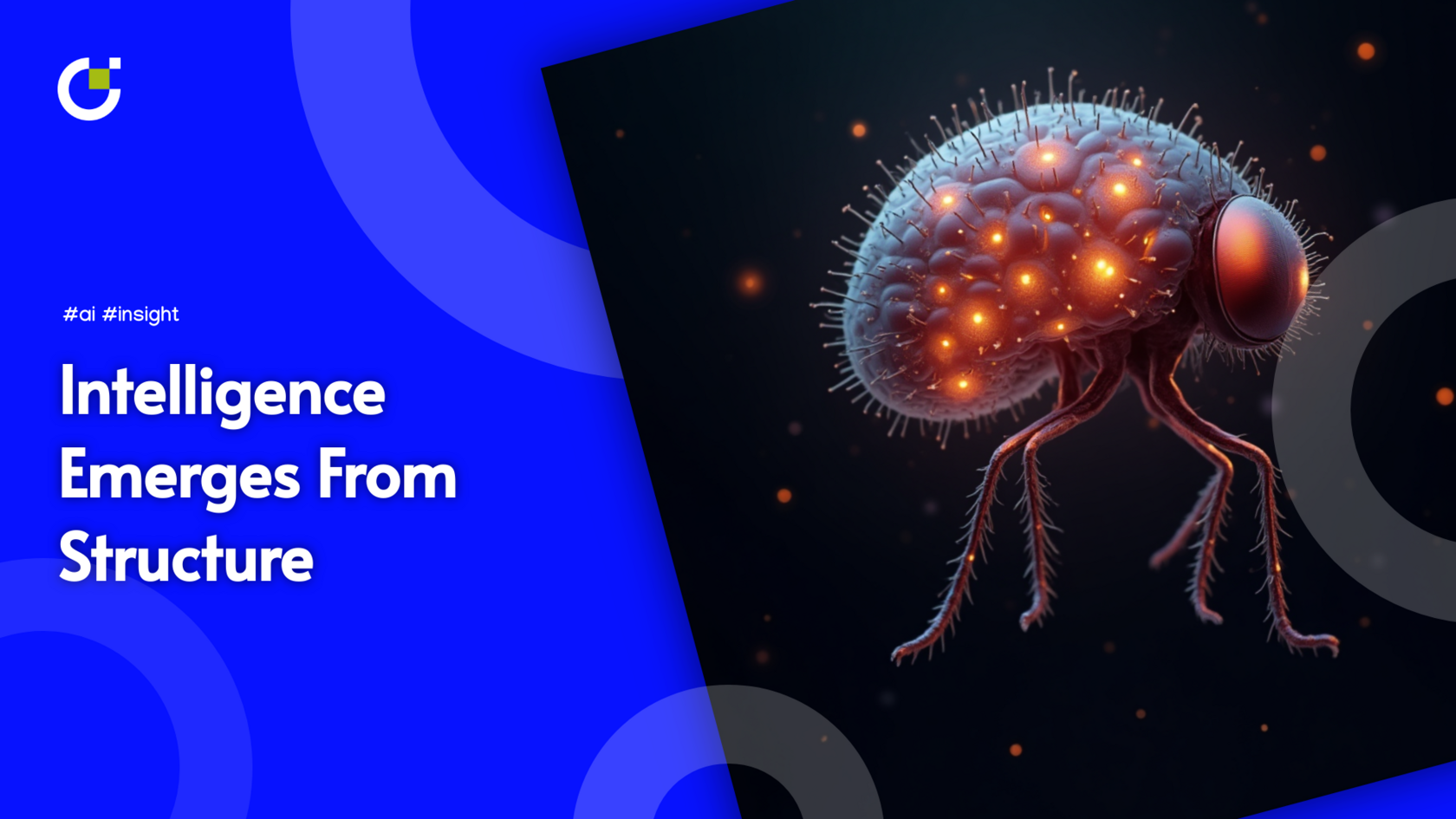
There is something quietly profound about the idea of a simulated fruit fly.
At first glance, it sounds like one of those stories that sits halfway between neuroscience and science fiction. A tiny brain mapped from a real insect, placed into a virtual body, and then allowed to behave like a fly. But the more we think about it, the less this feels like a novelty and the more it feels like an important shift in how intelligence might be studied.
What makes this work especially interesting is not just that the virtual fly behaves with high fidelity, reportedly around 91% behavioral accuracy. It is the way that result was achieved. This was not a model trained on huge behavioral datasets in the typical machine learning sense. The system was built from biological structure itself: neural connections, synapse weights, neuron types, and simple firing rules. In other words, the researchers did not ask an AI to imitate a fly. They tried to reconstruct the mechanisms that make a fly a fly.
That difference matters.
For years, much of modern AI has focused on outcomes. If a system produces the right answer, classifies the image, or generates fluent language, we call it successful. But biology reminds us that intelligence is not just a result. It is a process grounded in physical organization. A brain does not merely output behavior. It creates behavior through structure, timing, chemical balance, inhibition, excitation, embodiment, and adaptation.
This is why even a fruit fly can teach us something fundamental.
A fly brain has roughly 150,000 neurons. By human standards, that is tiny. Yet it is enough to navigate, react, balance competing stimuli, and produce behavior that is robust enough to survive in the real world. When a simulated version of that system begins to reproduce those patterns without being conventionally trained, it suggests that intelligence may be more deeply encoded in architecture than we often admit.
That idea has consequences well beyond insect neuroscience.
One lesson is that intelligence may be less about scale alone and more about the relationship between structure and environment. We often treat bigger models as better models. More parameters, more compute, more data. And to be fair, that approach has delivered remarkable progress. But the fly offers a different lens. It shows that meaningful behavior can emerge from a relatively compact system when its internal organization reflects the logic of a living organism.
This should make anyone working in software, AI, or systems design pause for a moment.
In engineering, we are often tempted to optimize from the outside in. We tweak outputs, improve metrics, expand datasets, and stack layers until something useful emerges. Biology tends to work from the inside out. Structure shapes function. Constraints create capability. The system is not simply trained into competence. It evolves into it.
That is part of what makes brain emulation such an intriguing direction. It is not only about copying nature for its own sake. It is about asking whether evolution has already discovered forms of computation that we still do not fully understand.
If that is true, then mapping and simulating nervous systems could become more than a neuroscience project. It could become a path toward new models of intelligence.
And there is a clear progression in scale that captures the imagination. Around 150,000 neurons in a fruit fly. Nearly 1 million in a honeybee. 8 million in a turtle. 35 million in a bat. Around 500 million in an octopus. Roughly 9 billion in a western gorilla. And in humans, depending on the source, often cited around 86 billion neurons.
Those numbers are humbling. They remind us how far we are from full human brain emulation. But they also create a roadmap. Once a fruit fly is no longer theoretical, the question changes. It is no longer can a biological brain be simulated in principle. It becomes how far can this approach scale, and what will we learn along the way?
That shift from philosophical possibility to engineering trajectory is where things get serious.
Of course, there is a tendency to jump immediately to the most dramatic endpoint: uploading consciousness. A digital self. A mind that can be copied, preserved, accelerated, or transferred into non-biological form. It is understandable why people go there. The moment we can simulate the mechanisms of a brain well enough, the old boundary between organism and machine starts to feel less stable.
Still, it is worth slowing down.
There are many stages between a convincing neural simulation and anything we would reasonably call a conscious digital person. A system can replicate behavior without sharing subjective experience. It can model perception and action without containing a sense of self. Even in humans, consciousness remains one of the hardest problems in science and philosophy. We do not yet have a settled model for why experience exists at all, let alone how to detect it in a machine or a simulation.
So while brain emulation may eventually force those questions into practical territory, we should resist the urge to act as if they are already solved. The mystery is still real.
At the same time, the practical benefits do not depend on solving consciousness first.
If we can emulate parts of the brain with increasing fidelity, medicine could change in meaningful ways. We might simulate diseased neural circuits and test interventions before applying them to patients. We might better understand neurodegeneration, psychiatric disorders, developmental conditions, and recovery after injury. A simulated brain could become not just a philosophical object, but a laboratory for treatment.
That prospect feels more immediate and more grounded than the more speculative visions. And honestly, it may be the more important one.
There is also an interesting tension between current AI and biological simulation. Today’s dominant AI systems are incredibly capable, but they are often opaque. They can perform tasks at high levels while offering limited insight into how their internal representations relate to the kinds of mechanisms we see in nature. Brain emulation pushes in the opposite direction. It starts with interpretable components rooted in biology and asks what behavior emerges.
In that sense, these two paths might eventually meet.
One path builds intelligence from data and optimization. The other rebuilds intelligence from anatomy and dynamics. They are not identical, but they are increasingly adjacent. As they converge, we may discover that the future of intelligence is neither purely artificial nor simply biological. It may be a hybrid understanding in which software learns from evolution, and neuroscience benefits from computational abstraction.
That is where this story becomes especially relevant for people outside neuroscience.
The fruit fly simulation is not only a milestone in one field. It is a reminder that complex behavior can arise from systems whose logic is discoverable, buildable, and testable. It encourages a more disciplined form of curiosity. Instead of asking only what a system can do, we are pushed to ask why it works, what structures enable it, and whether those structures can be transferred into other domains.
For a software team, that resonates. Good systems are not just performant. They are coherent. Their behavior follows from architecture. Their reliability comes from how parts relate, not just from how much power is thrown at them. The same may prove true, at a vastly more profound scale, for minds.
And then there is the stranger question in the background.
If we eventually learn to simulate a brain closely enough that its behavior becomes indistinguishable from an embodied organism, what exactly have we created? A model? A mind? A mirror? If a future human emulation claimed to remember childhood, fear death, or love someone, would those claims be less real because they occur in silicon rather than tissue?
These are not just technical questions. They are questions about identity, continuity, and moral status. They force us to ask whether consciousness depends on substrate, on pattern, on embodiment, or on something else entirely. They also force us to confront a possibility that used to belong mostly to fiction: that a being could be functionally human and yet ontologically unfamiliar.
Even simulation theory starts to feel less like a cultural curiosity and more like a reflection of our changing intuitions. The more credible simulated minds become, the easier it is to imagine reality itself as computational in some deeper sense. That does not make the theory true, of course. But it does explain why the idea keeps returning. As our tools improve, old metaphysical questions stop feeling abstract and start feeling strangely practical.
What stands out most to us, though, is not the spectacle of it all. It is the patience of the work. Progress here comes from mapping, measuring, reconstructing, and testing. It comes from careful models of synapses, neuron classes, and firing dynamics. It comes from technical humility. The researchers did not leap straight to grand conclusions. They built a system and asked whether structure could reproduce behavior.
That approach feels worth holding onto.
There is a lot of noise around AI right now, and a lot of pressure to talk in extremes. Either machines are about to surpass us in every dimension, or they are just statistical tools with no deeper significance. Reality is probably more interesting than either narrative. The simulated fly suggests that intelligence is neither magic nor trivial. It is deeply material, highly structured, and perhaps more reproducible than we once thought.
That should leave us neither alarmed nor complacent.
It should leave us attentive.
Because once even a tiny nervous system can be reconstructed well enough to behave like the real thing, the future is no longer just about bigger models or faster chips. It is about whether we are beginning to understand the actual machinery of mind. And if we are, then the implications will reach far beyond labs and papers.
They will touch medicine, computing, philosophy, and eventually our idea of what a person is.
A fruit fly is a small place to begin. But some thresholds are small only in appearance. Once crossed, they change the scale of every question that follows.
At first glance, it sounds like one of those stories that sits halfway between neuroscience and science fiction. A tiny brain mapped from a real insect, placed into a virtual body, and then allowed to behave like a fly. But the more we think about it, the less this feels like a novelty and the more it feels like an important shift in how intelligence might be studied.
What makes this work especially interesting is not just that the virtual fly behaves with high fidelity, reportedly around 91% behavioral accuracy. It is the way that result was achieved. This was not a model trained on huge behavioral datasets in the typical machine learning sense. The system was built from biological structure itself: neural connections, synapse weights, neuron types, and simple firing rules. In other words, the researchers did not ask an AI to imitate a fly. They tried to reconstruct the mechanisms that make a fly a fly.
That difference matters.
For years, much of modern AI has focused on outcomes. If a system produces the right answer, classifies the image, or generates fluent language, we call it successful. But biology reminds us that intelligence is not just a result. It is a process grounded in physical organization. A brain does not merely output behavior. It creates behavior through structure, timing, chemical balance, inhibition, excitation, embodiment, and adaptation.
This is why even a fruit fly can teach us something fundamental.
A fly brain has roughly 150,000 neurons. By human standards, that is tiny. Yet it is enough to navigate, react, balance competing stimuli, and produce behavior that is robust enough to survive in the real world. When a simulated version of that system begins to reproduce those patterns without being conventionally trained, it suggests that intelligence may be more deeply encoded in architecture than we often admit.
That idea has consequences well beyond insect neuroscience.
One lesson is that intelligence may be less about scale alone and more about the relationship between structure and environment. We often treat bigger models as better models. More parameters, more compute, more data. And to be fair, that approach has delivered remarkable progress. But the fly offers a different lens. It shows that meaningful behavior can emerge from a relatively compact system when its internal organization reflects the logic of a living organism.
This should make anyone working in software, AI, or systems design pause for a moment.
In engineering, we are often tempted to optimize from the outside in. We tweak outputs, improve metrics, expand datasets, and stack layers until something useful emerges. Biology tends to work from the inside out. Structure shapes function. Constraints create capability. The system is not simply trained into competence. It evolves into it.
That is part of what makes brain emulation such an intriguing direction. It is not only about copying nature for its own sake. It is about asking whether evolution has already discovered forms of computation that we still do not fully understand.
If that is true, then mapping and simulating nervous systems could become more than a neuroscience project. It could become a path toward new models of intelligence.
And there is a clear progression in scale that captures the imagination. Around 150,000 neurons in a fruit fly. Nearly 1 million in a honeybee. 8 million in a turtle. 35 million in a bat. Around 500 million in an octopus. Roughly 9 billion in a western gorilla. And in humans, depending on the source, often cited around 86 billion neurons.
Those numbers are humbling. They remind us how far we are from full human brain emulation. But they also create a roadmap. Once a fruit fly is no longer theoretical, the question changes. It is no longer can a biological brain be simulated in principle. It becomes how far can this approach scale, and what will we learn along the way?
That shift from philosophical possibility to engineering trajectory is where things get serious.
Of course, there is a tendency to jump immediately to the most dramatic endpoint: uploading consciousness. A digital self. A mind that can be copied, preserved, accelerated, or transferred into non-biological form. It is understandable why people go there. The moment we can simulate the mechanisms of a brain well enough, the old boundary between organism and machine starts to feel less stable.
Still, it is worth slowing down.
There are many stages between a convincing neural simulation and anything we would reasonably call a conscious digital person. A system can replicate behavior without sharing subjective experience. It can model perception and action without containing a sense of self. Even in humans, consciousness remains one of the hardest problems in science and philosophy. We do not yet have a settled model for why experience exists at all, let alone how to detect it in a machine or a simulation.
So while brain emulation may eventually force those questions into practical territory, we should resist the urge to act as if they are already solved. The mystery is still real.
At the same time, the practical benefits do not depend on solving consciousness first.
If we can emulate parts of the brain with increasing fidelity, medicine could change in meaningful ways. We might simulate diseased neural circuits and test interventions before applying them to patients. We might better understand neurodegeneration, psychiatric disorders, developmental conditions, and recovery after injury. A simulated brain could become not just a philosophical object, but a laboratory for treatment.
That prospect feels more immediate and more grounded than the more speculative visions. And honestly, it may be the more important one.
There is also an interesting tension between current AI and biological simulation. Today’s dominant AI systems are incredibly capable, but they are often opaque. They can perform tasks at high levels while offering limited insight into how their internal representations relate to the kinds of mechanisms we see in nature. Brain emulation pushes in the opposite direction. It starts with interpretable components rooted in biology and asks what behavior emerges.
In that sense, these two paths might eventually meet.
One path builds intelligence from data and optimization. The other rebuilds intelligence from anatomy and dynamics. They are not identical, but they are increasingly adjacent. As they converge, we may discover that the future of intelligence is neither purely artificial nor simply biological. It may be a hybrid understanding in which software learns from evolution, and neuroscience benefits from computational abstraction.
That is where this story becomes especially relevant for people outside neuroscience.
The fruit fly simulation is not only a milestone in one field. It is a reminder that complex behavior can arise from systems whose logic is discoverable, buildable, and testable. It encourages a more disciplined form of curiosity. Instead of asking only what a system can do, we are pushed to ask why it works, what structures enable it, and whether those structures can be transferred into other domains.
For a software team, that resonates. Good systems are not just performant. They are coherent. Their behavior follows from architecture. Their reliability comes from how parts relate, not just from how much power is thrown at them. The same may prove true, at a vastly more profound scale, for minds.
And then there is the stranger question in the background.
If we eventually learn to simulate a brain closely enough that its behavior becomes indistinguishable from an embodied organism, what exactly have we created? A model? A mind? A mirror? If a future human emulation claimed to remember childhood, fear death, or love someone, would those claims be less real because they occur in silicon rather than tissue?
These are not just technical questions. They are questions about identity, continuity, and moral status. They force us to ask whether consciousness depends on substrate, on pattern, on embodiment, or on something else entirely. They also force us to confront a possibility that used to belong mostly to fiction: that a being could be functionally human and yet ontologically unfamiliar.
Even simulation theory starts to feel less like a cultural curiosity and more like a reflection of our changing intuitions. The more credible simulated minds become, the easier it is to imagine reality itself as computational in some deeper sense. That does not make the theory true, of course. But it does explain why the idea keeps returning. As our tools improve, old metaphysical questions stop feeling abstract and start feeling strangely practical.
What stands out most to us, though, is not the spectacle of it all. It is the patience of the work. Progress here comes from mapping, measuring, reconstructing, and testing. It comes from careful models of synapses, neuron classes, and firing dynamics. It comes from technical humility. The researchers did not leap straight to grand conclusions. They built a system and asked whether structure could reproduce behavior.
That approach feels worth holding onto.
There is a lot of noise around AI right now, and a lot of pressure to talk in extremes. Either machines are about to surpass us in every dimension, or they are just statistical tools with no deeper significance. Reality is probably more interesting than either narrative. The simulated fly suggests that intelligence is neither magic nor trivial. It is deeply material, highly structured, and perhaps more reproducible than we once thought.
That should leave us neither alarmed nor complacent.
It should leave us attentive.
Because once even a tiny nervous system can be reconstructed well enough to behave like the real thing, the future is no longer just about bigger models or faster chips. It is about whether we are beginning to understand the actual machinery of mind. And if we are, then the implications will reach far beyond labs and papers.
They will touch medicine, computing, philosophy, and eventually our idea of what a person is.
A fruit fly is a small place to begin. But some thresholds are small only in appearance. Once crossed, they change the scale of every question that follows.